Is an Open-Door Policy Enough?

Updated: 18 hours ago
An open-door policy is simply an invitation. This article explores why employees may not walk through that door, how to tell whether your team feels safe speaking up, and what leaders can do to build psychological safety.
As a leader, many of us proudly state that we have an open-door policy. And that is a great policy to have. But is an open-door policy really what your team needs?
Picture this scenario. You are in an executive leadership meeting with leaders from across the organization when a topic comes up that pertains to your department. During the discussion, you learn that members of your team have been expressing concerns about things happening within your department.
Your first gut reaction is probably, Why didn't my team tell me directly? They know I have an open-door policy.
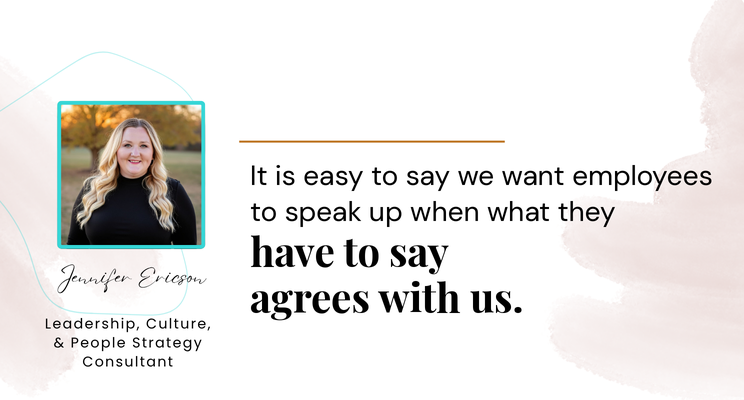
The reality is that an open-door policy is simply an invitation for someone to come talk to you. An invitation alone does not accomplish much if employees do not feel safe enough to walk through that door.
At its core, employees believe they can speak honestly without fear of judgment or retribution. They trust their thoughts and concerns will be heard and respected, even when the conversation is difficult. One of the clearest indicators that employees feel safe is their willingness to speak up.
Silence should never automatically be interpreted as agreement or satisfaction.
Silence should never automatically be interpreted as agreement or satisfaction.
Employees often remain silent because they believe nothing will change, they fear being viewed differently, or past experiences have taught them that speaking up carries risk.
Questions to Ask About Your Open-Door Policy
If employees feel safe speaking up, you’ll usually see it reflected in their day-to-day interactions. Here are a few questions to ask yourself as you reflect on your own team.
Do team members come to me when they have made a mistake so we can work through it together?
Do team members come to me directly when there is a problem we need to solve, or do I usually hear about it from someone else?
Do employees bring concerns directly to me instead of discussing them everywhere else?
These questions are not a test, but they can provide a starting point for reflection. Look at your team as a whole rather than one or two individuals, remembering that an environment that feels safe for one employee may not feel safe for another.
How to Help Employees Feel Safe
One of the best ways to help employees feel safe is to be genuine with them. Do not try to appear perfect. Admit when you make mistakes, acknowledge when you do not have all the answers, and demonstrate that learning is part of leadership.
Another important step is how you respond when employees do speak up. Resist the urge to become defensive or dismissive. Even when someone has made a mistake, be intentional with your language. You may not approve of the action, but you can still communicate that you value the individual.
If you consistently communicate openly, respond without judgment, and show employees that their voices matter, would that situation have happened?
Perhaps the real question is not whether your door is open. It is whether your leadership has convinced your team that it is safe to walk through it.
Whether your team is in Yuma or anywhere across the country, if you want support making your open-door policy a place employees actually feel safe to use, I'd love to talk. Schedule a consultation.


Comments