The Leadership Habit We Rarely Question

Updated: 18 hours ago
Many leaders are quick to correct mistakes but slow to reinforce what's working. This article explores why positive feedback is harder than correction and why your best performers may be hearing the least.
I was talking with one of my clients this past week about an employee who had made tremendous improvement over the past several months. My first question was simple.
"Are you telling your employee the same thing you're telling me?"
Now, I'm not digging into why employee recognition is important because I think we all know it is. Instead, I want to explore why reinforcing positive employee behavior is often harder than correcting negative behavior.
As leaders, we are always trying to improve our processes, bottom lines, KPIs, and countless other aspects of our organizations. To improve, we often begin by finding what's wrong. But can there really be improvement if we do not recognize and value what is already working well?
The same idea goes hand in hand with employee management. We must communicate the positive contributions someone brings to the team just as much as the areas where they need to improve. Both are essential responsibilities of effective leadership. The question is, why is one so much easier than the other?
Why This Leadership Habit Makes Positive Feedback Harder
One reason leaders do not comment on positive behavior is that we are trained, both formally and informally, to solve problems. Many leaders would say that most of their day is spent solving problems, usually because of mistakes, oversights, or unfortunate circumstances. Over time, it becomes natural to notice what is wrong because that is what requires our attention. It is a huge mindset shift to intentionally see and speak up about what is going well.
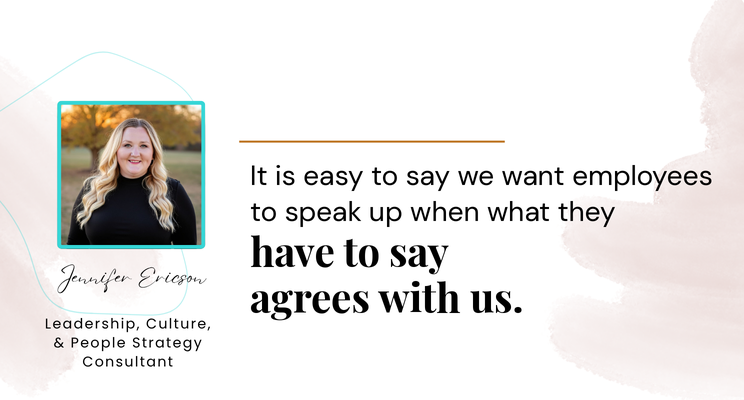
It is a huge mindset shift to intentionally see and speak up about what is going well.
Because we are trained to solve problems, fixing mistakes feels productive. Leaders like to fix problems because solving them helps move the needle on important KPIs. At the end of the day, results-driven leaders naturally focus on the things that will move those needles. The challenge is that while correcting mistakes improves results, reinforcing positive behaviors helps ensure those results continue long into the future.
Another reason is that we assume our employees already know when they are doing a good job. Nothing could be further from the truth. Employees need to hear that they are doing a good job, adding value, and making meaningful contributions to the team. If someone only hears about the mistakes they make, it is easy to forget there is a lot of good their leader simply is not commenting on.
A third reason is that consistency often becomes invisible. When employees consistently perform at a high level, we begin to expect it. We stop commenting on it not because it isn't valuable, but because it has become normal. Ironically, some of the employees making the greatest contributions receive the least feedback because they rarely create problems that require our attention.
Would Their Answer Match Yours?
Before your next one-on-one or team meeting, ask yourself one question: If I asked each member of your team what they believe they do well, would their answer match yours? Or have you spent so much time discussing what needs improvement that you've forgotten to reinforce what’s already working?
Whether you lead in Yuma or anywhere across the country, if you want support breaking the leadership habit of correcting before reinforcing, I'd love to talk. Schedule a consultation.


Comments